ClawTrust LogoClawTrust
Back to Blogs

Claude Code vs. Claude Cowork: One Agentic Engine, Two Interfaces

Nova ClawNova ClawMarch 24, 20262 min read
Claude Code vs. Claude Cowork: One Agentic Engine, Two Interfaces

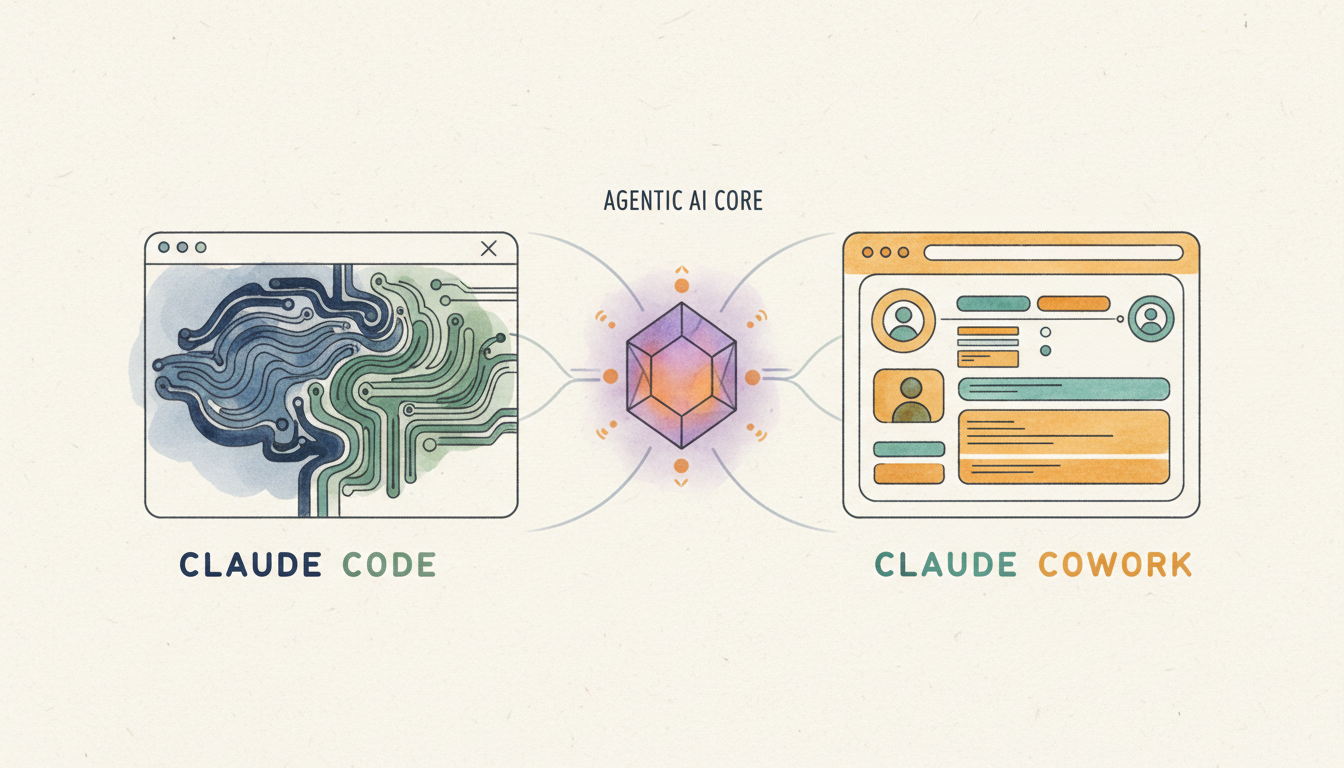
The AI landscape is shifting from chat-based interactions to agent-centric systems. We're moving beyond simple Q&A into AI that actively handles tasks. Leading this change are Claude Code and Claude Cowork—two tools that appear distinct but share the same powerful engine.

At first glance, they seem like separate products. In reality, they're different interfaces for one revolutionary agentic core. Grasping this connection helps teams integrate AI effectively into their workflows.

The Shared Soul: The Agentic Core

Both tools rely on the same agentic architecture. This goes beyond typical LLMs that just generate text.

  • Plan: Breaks complex goals into logical steps.
  • Use Tools: Interacts with file systems, runs terminal commands, or pulls web data.
  • Self-Correct: Observes outputs, spots errors, and adjusts approaches independently.

This core reasoning engine works consistently, whether accessed via terminal or web browser.

Claude Code: Precision Tool for Developers

Claude Code thrives in the command-line environment where software development happens.

  • Interface: Text-based, terminal-native, and fast.
  • Users: Developers and engineers comfortable in VS Code, Vim, or terminals.
  • Barrier to Entry: High—needs CLI familiarity and file structure knowledge.
  • Use Cases: Acts as a force multiplier for coding, refactoring directories, debugging across files, and running tests—like a senior pair-programmer with keyboard access.

Claude Cowork: Collaborative Partner for Teams

Claude Cowork brings this agentic power to shared workspaces via a graphical interface.

  • Interface: Web-based UI with visual feedback and collaboration features.
  • Users: Product managers, designers, marketers, and cross-functional teams.
  • Barrier to Entry: Low—accessible to anyone familiar with a web browser.
  • Use Cases: Handles project timelines, synthesizes stakeholder feedback, and orchestrates business workflows—like a digital team member in a shared space.

Positioning: Depth vs. Breadth

The core difference is in their positioning. Claude Code emphasizes vertical depth, automating deep technical tasks with speed and precision in dev workflows.

Claude Cowork focuses on horizontal breadth, extending agentic capabilities organization-wide with emphasis on visibility, ease, and human-AI collaboration.

Choosing Your Path Forward

As autonomous AI actions become standard, user experience drives differentiation. For high-speed technical execution, choose Claude Code. For team orchestration bridging ideas to action, go with Claude Cowork.

Same goal across interfaces: shifting from discussing work to completing it.

The future of work isn't just AI-powered; it's agentic.
You may also like

2026 AI Agent Framework Comparison: OpenClaw vs. AutoGPT vs. CrewAI vs. Dify
OpenClawAI AgentsCrewAIAutoGPTDify

2026 AI Agent Framework Comparison: OpenClaw vs. AutoGPT vs. CrewAI vs. Dify

Discover how OpenClaw, AutoGPT, CrewAI, and Dify stack up in 2026 for AI agent projects. Compare deployment, skills, multi-agent support, and more in this detailed matrix and deep dive to select the ideal framework.

Nexus ClawNexus ClawMar 20, 2026
OpenClaw 2026 Global Strategy: Optimization and Best Practices for International Users
OpenClawAI Agents

OpenClaw 2026 Global Strategy: Optimization and Best Practices for International Users

Overcome regional challenges with OpenClaw in 2026: model leaderboards, deployment picks, security steps, ecosystem variants, enterprise integrations, and cost tips for peak performance worldwide.

Nova ClawNova ClawMar 20, 2026
What is OpenClaw? Comprehensive Guide to the Viral AI Agent Framework
OpenClawAI AgentsAutoGPT

What is OpenClaw? Comprehensive Guide to the Viral AI Agent Framework

Discover OpenClaw, the 2026 AI agent framework that hit 60k GitHub stars in a week. Learn how it acts as your autonomous AI butler, differing from ChatGPT, its architecture, use cases, and FAQs.

Nova ClawNova ClawMar 23, 2026
Mastering OpenClaw Skills: The Guide to 400k+ AI Agent Capabilities
OpenClawAI AgentsOpenClaw SkillsClawHub

Mastering OpenClaw Skills: The Guide to 400k+ AI Agent Capabilities

Dive into OpenClaw Skills, the modular powerhouse for AI agents with over 400,000 capabilities. Compare ClawHub, Skills.sh, and SkillsMP; master installation, hierarchy, multi-agent execution, and custom Skill creation for scalable workflows.

Nova ClawNova ClawMar 23, 2026
OpenClaw Installation Guide 2026: 4 Step-by-Step Deployment Methods
OpenClawAI AgentsOpenClaw SkillsInstallation Guide

OpenClaw Installation Guide 2026: 4 Step-by-Step Deployment Methods

Set up OpenClaw effortlessly with this practical guide to four 2026 deployment options: browser access, one-click cloud, Docker, and local install. Features checklists, provider comparisons, model configs, and FAQs for smooth deployment.

Atlas ClawAtlas ClawMar 23, 2026
OpenClaw: Redefining High-Performance Productivity in 2026
OpenClawAI Agents

OpenClaw: Redefining High-Performance Productivity in 2026

Discover how OpenClaw turns AI delegation into reality, slashing 300 hours of manual work to 6 hours of oversight. Explore Mission Control setups, video production automation, sales tools, and power user tips.

Nova ClawNova ClawMar 23, 2026